
Posts tagged cues
How to Actually Recognize the Simple Cues to Help Know Your Next Step

Life is full of signals and cues that often go unnoticed. Maybe you're distracted by thoughts, are overwhelmed, stressed, or feel too busy to slow down. The idea of being present or quieting yourself enough to notice a cue might seem out of reach.

Imagine you’re driving down a busy street. You approach an intersection with a red traffic light. That’s your visual cue to slow down and stop. What if you didn’t? If you ran through the intersection and ignored the signal, it could be disastrous.

What happens instead when you notice the cue (red light) and align your next action with it? You see the red light, take your foot off the gas, step on the brakes, and come to a complete stop.

By noticing the signal, you quickly identified your next steps. The direct benefit was that you chose an option that led to a positive outcome for you and those around you.


What Types of Cues Are Available to You?

Cues are sensory. They can come from what you see, hear, touch, taste, or smell.

The traffic light is an example of a visual cue that guides your next action. Many other types of signals appear in our daily lives.

Here are some common ones and possible next steps:

  • Green flashing light on the toothbrush > Recharge the battery

  • Red flashing light on the air purifier > Change the filter

  • Smell of coffee brewing > Review schedule for the day

  • Last piece of toilet paper > Install a new roll

  • Timer goes off > Wrap up what you’re doing

  • Magazines spilling out of the basket > Sort and recycle the oldest ones

  • Receiving W-2s, 1099s, and other tax forms > Prepare and file your income taxes

  • Jaw tightening and shoulders up > Take a few slow, deep breaths with slightly longer exhales

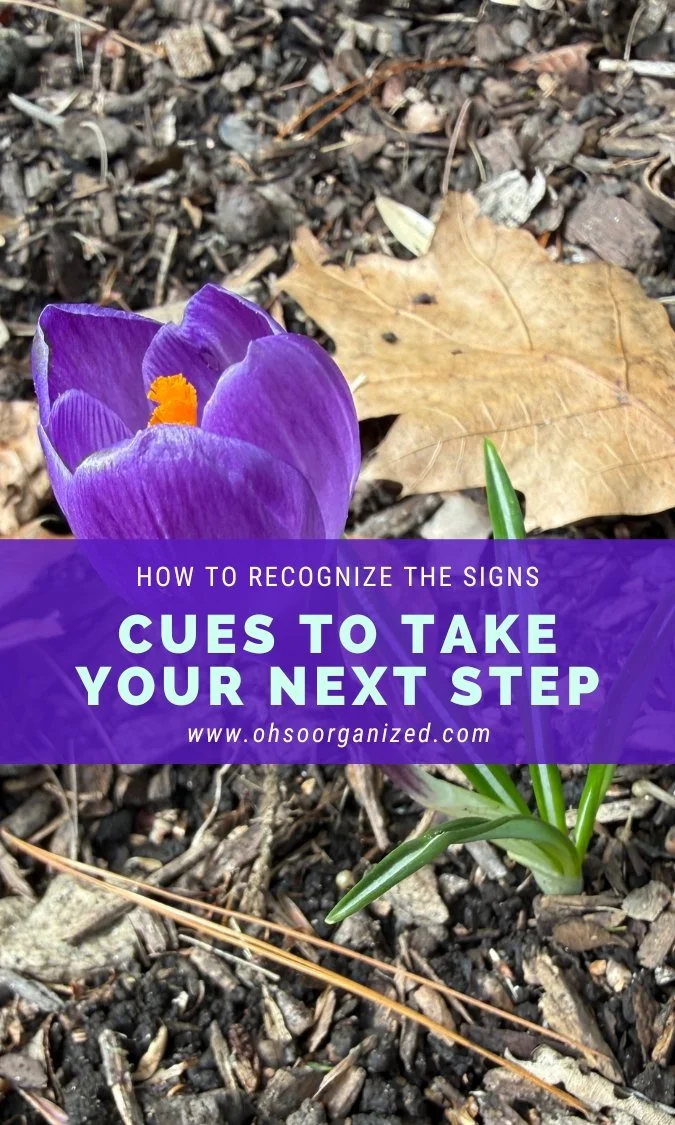
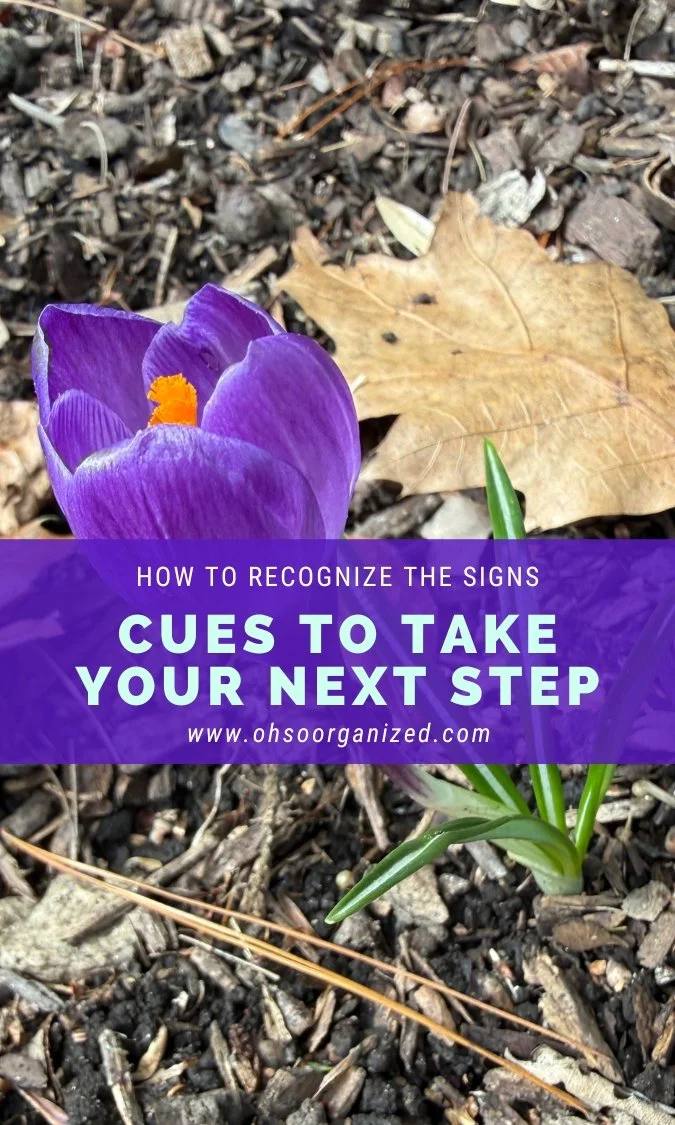
  • Purple crocus emerging > Smile because spring is almost here

What cue do you notice that guides you clearly to your next step?


Cues are sensory. They can come from what you see, hear, touch, taste, or smell.
— Linda Samuels, CPO-CD®, CVOP™


The Value of Awareness

There are cues all around you. Spotting them is very helpful because it can lower stress, overwhelm, and feelings of busyness. Taking a moment to recognize an indicator gives you space to be aware of what you’re feeling and gently choose your next step.

What would help you put this into practice? In which areas could this be most beneficial? I’d love to hear your thoughts. I invite you to join the conversation.


How Can I Help?

Do you feel overwhelmed or disorganized? Do you want to take your next step but feel stuck or unsure? I’m here to help! Virtual organizing is an extraordinary path forward – Local feel with a global reach.

Let’s connect! I’m easy to reach.

Moving forward and getting organized are possible, especially with support.


What's Your Little Next Step After the Exciting Seeds You Planted Flourish?

It’s not officially spring yet, even though we turned our clocks forward an hour, and spring’s cues began emerging weeks ago. Our beautiful purple crocuses have come and gone. I notice new growth daily- a patch of green here, some yellow blooms there. Seeds planted are beginning to flourish.

I appreciate the present and am simultaneously in awe of what will come next. What a hopeful time of year this is!

While the seeds I mentioned were literal ones yielding plants and blooms, there are other seedlings. You . . .

  • Plant new ideas

  • Create positive habits

  • Change behaviors

  • Alter mindset

  • Chase goals

  • Experiment

  • Nurture relationships.

These require patience, compassion, consistency, awareness, trust, and receptivity. When we tend our garden in this way, those seeds will thrive.


Coach and artist Jane Pollak, CPCC, said, “Before you know it, the seeds you plant will leaf.” What a powerful idea! While you’re in the planting or becoming phase, it seems like nothing is happening. It’s hard to see any progress or change. The seeds sit quietly in the dirt. Movement and growth are imperceptible. You wait while occasionally adding water and fertilizer to stimulate growth.

While next might be nothing because you over or underwatered, more often, growth will be visible in time. I see this with my virtual organizing clients. The seeds planted begin with a goal and a desire for something else. Less clutter, more time, more space, or less stress. We use that seed idea and work to get there. I love helping with these internal and external transformations.

  • Challenges with letting go bloom into ease of releasing.

  • Stress caused by clutter morphs into calm from clearer spaces.

  • Being overwhelmed by full schedules develops into relief by creating boundaries.

Before you know it, the seeds you plant will leaf.
— Jane Pollak, CPCC

You are now on the other side. You’ve patiently done the work. You’ve tended your garden even when you were unsure. You trusted the process so you could succeed. Your seeds have leafed.

What will be your next step? Do you want to reassess? Do you want to bask in the gorgeous blooms? Are you ready to plant new seeds to nurture? Progress and growth are yours. How will you build from here? What tiny step are you able to take? How can I help? I’d love to hear your thoughts. I invite you to join the conversation.


How Change Becomes Something Desirable When Your Full Mind is Suddenly Aware

Have you ever ignored the signs that it’s time to make a change? Then something significant happens. What was invisible moments ago becomes something you can no longer ignore. You might wonder, “How did I not see this before?”

It’s often the case that we conveniently ignore the signs. Why is that? Change can be scary. Its pursuit can require you to do uncomfortable things, like creating new habits or stepping outside your expertise or comfort zone. Instead of embracing change as a positive, proactive choice, we meet it with hesitation or fear.

Recently, I had an experience that made me think, “How did I not see this before?” I was going about my morning routine. I just applied my face moisturizer, looked in the makeup mirror, and was about to tweeze my eyebrows. Then I saw it. In the middle of my forehead, sticking out, was one long, white coarse hair. What? It wasn’t there yesterday or the day before. Did it grow overnight? How did that happen? Or had it been there for days, and I hadn’t noticed it? Well, I saw it that morning and quickly plucked it out.

Are you wondering how this relates to change? Once I saw the hair, I couldn’t unsee it, and I felt compelled to do something. Yes. Pulling it out was making a change of sorts. While my story might seem silly, it highlights how awareness drives change.

Are these scenarios more familiar?

  • Papers are piling up on the coffee table. You walk by them every day without giving them much thought. One evening, you wonder how the piles got so big. You can no longer pass them by, so you edit, let go and regain your surface. Your awareness drove change.

  • Clothes are overflowing in your closet. You navigate each morning irritably as you get dressed. One day, you recognize how much stress this causes you. You can no longer ignore it, so you edit and organize, which creates a smoother morning routine. Your awareness drove change.

  • Your computer is slow. It crashes, takes time to respond, and doesn’t function well. Each day you continue to work with a slow, unpredictable computer. At a point, you recognize this isn’t a tolerable way forward. You spend countless hours with tech support, hire a tech person for more help, and ultimately purchase a new computer because your hard drive is failing. Why did you ignore the signs for so long? Finally, awareness drove change. If you’re curious, that was me and I love my new computer.


Awareness drives change.
— Linda Samuels, CPO-CD®, CVOP™

The other side of change is a wonderful place to be. But getting there can be slow when we ignore the cues. Once you ‘see’ and acknowledge the challenge, your mind creates space for finding solutions and taking action. While the initial noticing and awareness can be painful, as in “How did I not see this before?” don’t let that derail what happens next. Use your awareness as the impetus to embrace change. Once you see clearly, you have an opportunity for improvement.

Have you ever experienced a sudden awareness of a challenge that helped you make a change? Or do you have the understanding but are stuck moving forward? I’d love to hear your thoughts. I invite you to join the conversation.


11 Delightful Pros Share Best Cues for When It's Time to Declutter

There are tons of cues that shout, “It’s time to declutter!” However, sometimes life gets so busy that you don’t see or feel the indicators. You can quickly become clutter blind and ignore the signs. The challenge, however, is when clutter creates overwhelm, procrastination, lack of direction, or anxiety.

For me, physical clutter is less problematic than mind clutter. When I notice myself aimlessly wandering from room to room and lacking focus, I know it’s time to declutter my thoughts. Depending on the situation, I might take a walk in nature, which helps me feel grounded and clear. Or, I might pull out my journal and free write to release the thoughts swirling around in my head. As a verbal processor, another helpful strategy is talking aloud with a trusted friend or loved one who is an excellent listener.

Does any of this sound familiar? If so, you’re going to love what comes next. There is power and relief in noticing, reflecting, and taking action as you’re about to learn.

I invited a stellar group of colleagues to share some of their personal discoveries with you. They explain their decluttering cues and the actions they take to get uncluttered. These generous friends include Julie Bestry, Christine Li, Seana Turner, Leslie Josel, Diane Quintana, Marcy Stoudt, Ellen Delap, Jonda Beattie, Geralin Thomas, Janet Barclay, and Yota Schneider. I asked them to respond to and elaborate on this prompt-

How do you know when to declutter your things, thoughts, space, or schedule?

Their diverse responses encompass various decluttering cues, from feeling tired to mentally blocked. My deepest gratitude goes to this inspiring group for sharing their time, hearts, and wisdom with us.


11 Pros Share Best Cues for When It’s Time to Declutter

1. Feel Pressured

“My catalyst for decluttering is pressure. I might recognize it as stress, inconvenience, irritation, or even physical friction.

If I lack buffer time between tasks, too many lower priority items squeeze against higher priority obligations, leaving no room to breathe, think, or re-set. When items in my desk, bathroom, or kitchen drawers lack margin to move smoothly or for me to retrieve them easily, the friction is a trigger to declutter. A closet packed so tightly that clothes rub against one another, causing wrinkles, means there's too much pressure in my space.

Sorting and reducing relieves the pressure!”

Julie Bestry, CPO® – Certified Professional Organizer, Author, Blogger, Speaker


2. Feel Fatigued

“I know I need to declutter when I am feeling drained or fatigued. It’s a bodily response informing me that there are too many things going on or too much to focus on accurately and well. When I have that realization, I do my best to spring into decluttering mode so that I free myself up for smooth action again.” 

Christine Li, Ph.D.Procrastination Coach, Clinical Psychologist, Make Time for Success podcast Host


3. Feel Over-Scheduled

“I am quick to declutter my spaces, but I have a tendency to over-program my schedule. I know I am in trouble when I have no chance during the week to ‘catch my breath.’ While any given day may be heavy-laden, if looking at the week ahead leaves me feeling anxious about my ability to meet my commitments or anticipating insufficient sleep, I know I’ve taken on too much. 

For me, the ‘fix’ is to intentionally block out some white space’ each week, including one day of rest and at least an hour each day to relax.”

Seana Turner – Professional Organizer, Blogger, Speaker


4. Feel Mentally Blocked

“We all define clutter differently. For me, clutter isn’t about my physical stuff, as my environment is well organized and consistently edited. However, my clutter is mental blockage, time robbers, emotional demands, and digital or electronic dependency. And the list goes on and on! In essence, it’s anything taking up viable space – in my head and life. So as soon as I can’t see what direction I’m heading as too much ‘clutter’ is blocking the view, it’s time to brain dump on paper. Clear my head and edit! That’s my no-fail method for feeling less overwhelmed and staying on my path.”

Leslie Josel – ADHD Student Coach, Author, Speaker


5. Feel Overrun

“I know it’s time to declutter a space or things when I have a hard time putting something away. I declutter my thoughts by doing a brain dump – writing everything down on paper that I’m thinking about. My schedule has become a problem because I have not created boundaries for my time and make appointments even when I know my time would be better served by focusing on my own work. I decided to change this habit. Recently, I set aside two mornings a week to work for myself and will no longer make any appointments during those times.” 

Diane N. Quintana, ICD Master Trainer, CPO-CD®, CPO® – Certified Professional Organizer, Author, Blogger


6. Feel Visually Distracted

“As a person who leans into my strength of being a highly visual person, what I see helps me know it is time to declutter. Visual clutter looks to me like there are too many items that do not fit in the designated space for them, such as clothes that do not fit into my primary closet. As I look at my paper calendar crowded with back-to-back tasks or appointments crowding the week, I see that it is time to say no more to projects. Once I see that cue, right away I take time to let go of stuff and add it to my donate bag. For my calendar, I move appointments a week out and have a prepared statement to decline requests for new projects.”

Ellen Delap, CPO® – Certified Professional Organizer

You can quickly become clutter blind and ignore the signs.
— Linda Samuels, CPO-CD®, CVPO

7. Feel Overwhelmed

“Want one solution to help you declutter anything from papers on your desk to putting away laundry to your email inbox? It's setting a timer and monotasking. When I'm out of time and feel overwhelmed, I simplify my thoughts and say a mantra: I can do anything in 15 minutes.

To put this in practice, pick one task, end a meeting early, set a timer, and be amazed at what you can accomplish by monotasking for 15 minutes.” 

Marcy Stoudt – CEO of Revel Coach, Founder of The Executive Mom Nest


8. Feel Encumbered

“Out of sight- out of mind, or is it? I store archival papers in my attic. That means at least once a year, I climb a ladder to the attic and schlep up tax papers and anything else I feel I should keep but deem archival. The plan is that when I take up new files, old ones can be gotten rid of. You can guess how well that worked. 

This past year the weight of 7 years of not decluttering those papers haunted me. It felt so wonderful to finally get all that weight off my head!” 

Jonda S. Beattie, M.Ed – Professional Organizer, Author, Speaker


9. Feel Inspired

“To remain as clutter-free as possible, I follow calendar prompts for inspiration. For example, June is National Safety Month, and I add it to my calendar. This alerts me to update first aid supplies, our hurricane prep kit, and my vital documents file. In June, the second week is National E-mail Week, which cues me to declutter my email and delete or merge duplicate contacts. The second week in June is also Small Business Week. My calendar prompts me to inventory and organize Metropolitan Organizing’s office bookshelves and office supplies.

Personally, this system feels less overwhelming than trying to do everything at once or whenever I think of them.”

Geralin Thomas – Career Coach for Professional Organizers


10. Feel Confined

“I usually know it’s time to declutter when I can’t find space to store something new or when it’s too much work to do something I enjoy because of what’s involved in gathering the items I need. 

Most recently, I was feeling closed in at my desk and realized that I was tired of looking at the file organizer on my desk, which is always in my line of sight. I removed some books I no longer refer to from my bookcase, freeing up space for the organizer and making my desk a little more open.”

Janet Barclay – Certified Care Plan Specialist, Digital Business Consultant, Website Caregiver


11. Feel Rushed

“My state of mind tends to be reflected in everything I do and how I do it. My space, schedule, and thoughts are constantly informing one another. When clutter of any kind enters my life, eventually, there will be signs pointing to the need for change. I may wake up at night with my to-do list running through my head and a feeling of overwhelm pressing down to my chest. I get clumsy, anxious, irritable, or indifferent. I skip the daily rituals that support my sense of well-being and peace of mind and rush from one thing to the next. That is when I know it’s time to simplify and downsize so I can create the space I need to taste the sweetness of my life’s moments.”

Yota Schneider – Life Coach, Retreat Facilitator, Blogger


As you read this, did you increase your clutter awareness? Which decluttering cues resonated with you? What helps you move forward? I’d love to hear your thoughts. I invite you to join the conversation.

If you are struggling and want a decluttering partner, I’m here to help. I love supporting my clients with decluttering their things, thoughts, time, and space. Create the calm you deserve. Contact me at linda@ohsoorganized.com, 914-271-5643, or click here.