Posts tagged planning
How a Fantastic Conference Taught Me More About Virtual Organizing

Recently, I returned from the Institute for Challenging Disorganization’s (ICD) conference, held in Canada this year. Colleagues from around the globe gathered to learn, connect, and explore the latest ideas and research related to neurodivergence and people affected by chronic disorganization.

The conference covered a fascinating range of topics, including ADHD, decision-making, navigating life transitions, clutter, emotional labor, hoarding disorder, motivational interviewing, and communication.

I was thrilled to be part of the panel, “Cultivating Connection: Best Practices for Communication with Neurodivergent Clients,” alongside my wonderful colleagues. Sara Skillen moderated, and Leslie Josel and Elizabeth Brink were the other panelists.

Whenever I’m learning, I have one goal: to learn at least one new thing, discover one new resource, or deepen my connection with something I already know. Honestly, with that simple goal, I consistently come away with far more than one thing.

The ICD conference was no exception.

I’m excited to share some of my takeaways and how they expanded my thinking, reinforced what I already know, and will influence the virtual organizing work I do with clients.


What Expanded My Thinking About Virtual Organizing

Emotional Labor

In “The Art of the Invisible: Helping Neurodiverse Families Navigate the Emotional Labor Lifecycle,” presenters Regina Lark, PhD, CPO®, CPO-CD® and Leslie Josel, PCC, discussed how emotional labor, which is mostly invisible and disproportionately handled by moms, is “the exhausting work” and the “cognitive management of household systems.”

Navigating emotional labor, work that never ends, requires executive function (EF) skills that rely heavily on the prefrontal cortex. These include:

  • Planning

  • Focusing

  • Remembering instructions

  • Juggling multiple tasks

  • Managing emotions

  • Working memory

  • Organizing

However, as many of my clients have experienced, EF skills can be especially challenging if you are highly stressed, have prefrontal cortex damage, or have conditions such as ADHD, autism, dyslexia, dyspraxia, or Tourette’s syndrome.

One of the biggest takeaways was distributing the emotional load through “radical delegation. Take perfection off the table. Delegate to someone else, even if they aren’t good at it.  Go for “good enough.”

This made me think differently about virtual organizing. When we work together, we’re not only organizing possessions or creating systems. We’re also considering the mental load behind those systems. What decisions are constantly being made? What is someone trying to remember? What are they managing for themselves or others? And what might be possible to let go of, share, or accept as “good enough”?

Life Transitions

We experience many life transitions. Professor and researcher Dr. Michelle Pannor Silver focused on four in her presentation, “Unpacking Identity: Navigating Later Life Transitions for Those with Organizational Challenges.” She discussed retirement, menopause, clutter, and prioritizing physical resilience.

Much of my work involves helping clients navigate transitions such as moving, starting a new job, divorce, birth, losing a loved one, and other life changes like those Dr. Silver discussed.

One takeaway came from the retirement section. Since our identities are often tied to our work, figuring out what comes next takes thought. Silver stressed the importance of creating “time and mental space to imagine retirement.” It’s not just about getting your finances in order. Take time to envision how you want your post-work life to feel and what you want it to be like. Include “sparking joy” activities.

Another idea that resonated was “recalibrating after loss.” In later years, loss can arrive in many forms, including changes in work status, moving from a familiar environment, changes in physical or cognitive abilities, and the loss of loved ones.

I am thinking differently about virtual organizing in the context of reimagining and recalibrating life. We go through periods when the organizational systems or patterns that used to work suddenly become ineffective. They no longer support who we are now. Virtual organizing sessions can be a wonderful way to work through these shifts and create systems and schedules that support who you are now.

“Decision-making is at the center of everything. It is a core part of being human.”
— Elizabeth Brink, PCC, PCNC®, SEP®

What Reinforced What I Already Know About Virtual Organizing

ADHD

Ari Tuckman, PsyD, MBA, presented “ADHD Can Make Organizing Psychologically Messy.” He emphasized that the ADHD challenge is “not the knowing, but the doing.” Challenges with activation, attention regulation, perfectionism, and time management can make it harder to start. You might know what to do, but these obstacles can make it challenging to get things done.

One question Tuckman suggested was, “What’s a realistic, sustainable goal that you’ll allow yourself to feel good about?” Emphasizing “realistic” and “sustainable” is central to my work with clients.

Tuckman shared many strategies that reinforced the tools and concepts I use with clients. They included:

  • Time – Use analog clocks, alarms, and schedules to build time awareness and make time more visible.

  • Fun – Make tasks less boring and more enjoyable through gamification or a playful spin.

  • Clarify – Ask, “How important is ‘this’ relative to everything else?”

  • Momentum – Do a “bit of something,” and always “hope for momentum.”

  • Experiment – “Be willing to flounder, and be confused.”

  • Decision-Making– If you are having difficulty choosing, flip a coin. It can clarify what you really want.

  • Perfectionism – Focus on “good enough.”

These strategies reflect what I see every day in virtual organizing: knowing what to do and being able to do it aren’t always the same. Virtual organizing sessions can help clients identify what gets in the way, experiment with different approaches, and find strategies that are realistic and sustainable for them.

Decision-Making

Elizabeth Brink, PCC, PCNC®, SEP®, a neurodivergent-centered coach, educator, and trainer, presented “Decision-Making: Neurodivergence, Trauma, and Chronic Disorganization.” Brink stated, “Decision-making is at the center of everything. It is a core part of being human.”

Brink went on to say that “Decision-making is a special kind of hard for neurodivergent humans.” She also said that for neurodivergent people, “Overwhelm is a reasonable response to decision-making.”

When Brink said, “It’s a big deal how to help people make decisions,” I recognized how central nurturing decision-making skills and building agency are to my virtual organizing work. People reach out to me when they feel overwhelmed, and much of that overwhelm comes from difficulty making decisions.

Decision-making skills can be learned. Brink featured several skill-building strategies that align with how I support my clients in making decisions. They include:

  • Empathy – Understand and appreciate what they may be feeling or experiencing, without judgment.

  • Demystify – Learn how they make decisions, what’s worked well for them in the past, the process they’ve used, and how we can tweak or apply that process to current choices.

  • Capacity – Be mindful of their capacity at that moment, normalize pauses, take breaks to avoid decision fatigue, and encourage a slower pace when needed.

Always Be Learning

Every conference leaves me with something to think about, but this one reminded me why I value learning so much. Sometimes a new idea changes how I approach my work. Other times, it gives me language for what I already know and see in my work with clients. Both are valuable.

I’m excited to bring these insights into my virtual organizing sessions and stay curious, experiment, and learn alongside my clients.

How Can I Help?

Do you feel overwhelmed, stuck, or disorganized? You don’t have to face it alone. I’m here to help! Get unstuck and make progress. Virtual organizing is an extraordinary path forward—with a local feel and a global reach.

Let’s talk! I’m easy to reach.

Getting organized, making progress, and reaching your goals are doable, especially with support.


Did You Know That Taking Breaks Is Key to Better Time Management?

When you think about managing your time, how often is it about being more productive, reaching those big goals, or getting more items crossed off your to-do list today? You wonder how other people get so much done. You’re frustrated that you’re constantly working, yet your lists and goals feel hard to finish or even to start.

After all, there are only 24 hours in a day. For most of us, at least six to eight of those hours are devoted to sleep. Subtract time for eating, transitions, bio breaks, managing distractions, and handling the unexpected, and your available time to get things done is significantly reduced.

I remember my mom used to get annoyed about having to sleep. She would say, “We sleep a third of our lives away. Sleeping is a waste of time.” I never bought into the idea that sleep was a waste. Instead, I saw her words as reflecting her intense need to make the most of every moment.

I’m all for making the most of the time I have. Time is finite and a precious resource. However, one of the best ways to manage your time better is to take intentional breaks. Sleep is one aspect, but taking breaks while awake is just as essential.


What Types of Breaks Will Help You Be a Better Time Manager?

I know I’m stating the obvious, but you need energy and focus to get things done. Working longer or beyond capacity doesn’t help. You’ve probably reached the point of diminishing returns. You know those nights. You’re exhausted, pushing to finish that spreadsheet, dealing with a sink full of dishes, packing for a trip, or writing one more email response.

However, understanding the benefits of taking breaks and integrating them into your life will help.

It’s more than ‘will help.’ Taking breaks is essential not only for energy, focus, and getting things done but also for your overall well-being. Life isn’t only about doing more. It’s about stepping away for short, medium, or longer breaks.

What can these mid-size breaks look like? Let’s review some options to help you better manage your time. These pauses are about giving you time to recover so you can return to ‘the work’ refreshed, recharged, and energized.


1. Short Breaks

You might be thinking, “I’m so busy that I barely have time for a bio break, let alone any other break.” Believe me, I get it. You are not alone in feeling overwhelmed by the pace of life.

However, it is possible to integrate several short breaks into your day. If “short” feels too long, reframe it as a micro-break.

These tiny resets can be taken a few times a day and may include:

  • Close your eyes and take several slow breaths in and out.

  • Stand up and shake out your body.

  • Send a quick email or text to someone you love.

  • Enjoy a few leisurely sips of coffee or iced tea.

  • Eat a snack.

  • Doodle on a sheet of paper.

  • Go outside for fresh air.

  • Take a walk around the office or the block.

  • Roll your shoulders forward and backward.

  • Dance or sing loudly to a favorite song.

  • Take a few deep, loud sighs.

  • Splash cold water on your face.

  • Sit and do nothing for a few minutes.

  • Meditate for 1 to 5 minutes. Insight Timer offers many excellent options.

What else could work well for your micro-break?


“Life isn’t only about doing more.”
— Linda Samuels, CPO-CD®, CVOP™

2. Medium Breaks

Those mini breaks are wonderful, but at times you will benefit from something longer. If you can carve out more than 5 minutes, a medium break is beneficial. While micro-breaks can be impromptu, a medium break might require some advance planning.

Here are some recharge ideas for breaks ranging from 20 minutes to several hours:

  • Take a 20-minute nap.

  • Go to the movies.

  • Take a walk in nature.

  • Meet a friend for lunch.

  • Explore a museum, garden, or town.

  • Get a massage.

  • Meditate for 30 minutes.

  • Write in your journal.

  • Call a loved one.

  • Go to the pool or the beach.

  • Read a book (or a portion of one).

  • Spend time in a hammock.

  • Go for a bike ride.

  • Make something with your hands.

  • Daydream.

  • Take a yoga class.

What other types of medium breaks could benefit you?


3. Long Breaks

Full disclosure here. Today I took a micro break (meditated) and a medium break (walked by the river). I also just returned from a long break, a family vacation in the Finger Lakes. I have to say, as much as I need my shorter breaks regularly, the extended ones are just as vital. They can be more challenging to take because of the expense or limited time.

Yet, going somewhere for several days (if possible) and stepping away from your regular routines and responsibilities is one of the best ways to recharge. You will return refreshed, more focused, and ready to re-engage with your projects and lists.

It also gives you time to float, think, catch up on sleep, connect with family and friends, or simply do nothing. But a long break doesn’t have to mean only getting away.

Here are some long-break ideas when you have more than 24 hours:

  • Take a staycation and stick to fun or relaxing activities.

  • Take a personal retreat focused on rest and reflection.

  • Unplug for several days.

  • Learn a new skill just for fun.

  • Create a home retreat with no obligations, errands, or projects.

  • Go away for the weekend, or extend it to a long weekend.

  • Vacation somewhere you have to fly to.

  • Travel to somewhere on your bucket list.

  • Check into a spa or wellness retreat.

  • Go camping or glamping.

  • Vacation somewhere reachable by car.

  • Take a biking, kayaking, or boating trip.

  • Spend an extended visit with loved ones.

What have you enjoyed most during your long breaks?


Are You Ready to Give Yourself the Breaks You Deserve?

Busy is how many of you describe your lives. There’s nothing inherently wrong with a full life. But make sure you also take a variety of intentional breaks. Breaks are the yin to your ‘busy’ yang.

Do you take regular breaks? What types do you take? Would you benefit from adding more pauses to your life? How would taking more breaks help you manage your time better? I’d love to hear your thoughts. I invite you to join the conversation.


How Can I Help?

Do you feel overwhelmed, disorganized, and have difficulty managing your time? I’m here to help! You don’t have to do this alone. Virtual organizing is an extraordinary path forward – Local feel with a global reach.

Let’s connect! I’m easy to reach.

Managing your time, getting organized, and living with more ease are possible, especially with support.
 
 
3 Useful Ways for Better and More Compassionate Time Management

You and I share at least two things in common. We both have 24 hours in a day, and our days are finite. Yet how we experience and use our time varies widely.

Perhaps you are time-aware. You know how much time you have and spend it intentionally. Or maybe you have difficulty keeping track of time, feel time-poor, are easily distracted, and never have enough hours to get things done.

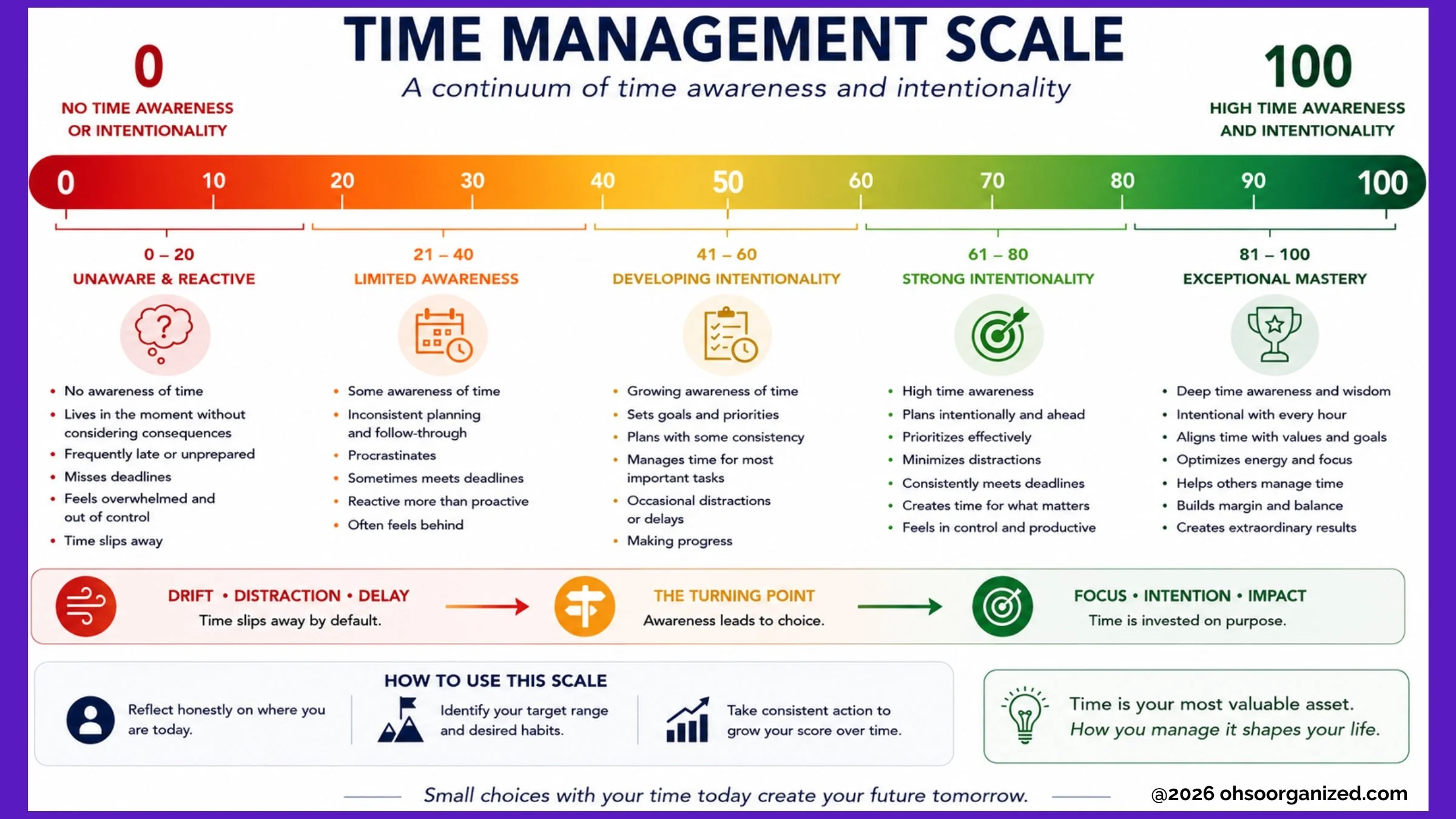
If you think of your relationship to time on a scale from zero to one hundred, with one end representing a total lack of time awareness and intentionality and the other representing high time awareness and intentionality, where would you place yourself? Whether your number is zero or one hundred, several concepts can improve your relationship with time and help you approach it more compassionately.


Time Management Scale

Before I share the strategies, review the Time Management Scale to get a sense of where you are right now. This isn’t an exact science, but the scale will help you identify your strengths and challenges. Understanding your relationship with time, combined with the concepts I’m about to share, can be a game-changer for you.

How to Use the Scale

  • Reflect honestly on where you are today

  • Identify your target range and desired habits

  • Take consistent action to improve your score over time

Remember that small choices about how you spend your time today shape your future.


3 Ideas to Encourage More Compassionate and Aligned Time Management

There are three ways to align your time in a more compassionate and powerful way. As I mentioned earlier, the time available each day is fixed. Your life and the time you have left are finite. None of us knows how many days remain. How you use this precious resource shapes your life.

1. Energy

Have you noticed how your energy ebbs and flows throughout the day? For example, I have more energy and mental clarity earlier in the day, and my energy lessens as the day goes on. Matching high-brain-demand tasks, such as planning or writing, with the time of day I’m ‘fully charged’ works better for me. Lower-brain-demand tasks, like resetting spaces or grocery shopping, can be done when my energy is less.

As you plan your available time and how you will spend it, factor in your energy. A while ago, Executive Coach Marcy Stoudt introduced me to the reframing of time management as energy management.

It’s helpful to consider how you’re planning and using your time. One thing I’ve learned is how much longer tasks take when my energy isn’t aligned. For example, when I’m tired and my energy is low, it takes me two to three times as long to do certain tasks as when I’m well-rested and in my high-energy, brain-power part of the day.

Aligning your energy management with how you use your time is a compassionate practice.

“Small choices about how you spend your time today shape your future.”
— Linda Samuels, CPO-CD®, CVOP™

2. Priorities

Have you noticed that some priorities, especially those tied to values, are fixed while others are flexible? For example, family might always be a top priority, so you’ll drop everything if someone in your family needs you. Or, when planning, family considerations drive your choices.

Flexible priorities are tasks, goals, and commitments that matter but don’t require immediate action or have a set deadline.

Flexible priorities could include:

  • Projects with open deadlines

  • Buy groceries sometime this week

  • Meet a friend for coffee in the next few months

  • Edit belongings to downsize

  • Plant flowers in the garden

  • Clean out the garage this season

  • Improve sleep habits

  • Try a meditation app

When considering your available time, aligning your priorities with your values and clarifying which tasks are fixed or flexible can lead to a more compassionate way forward.


3. Reality

Ah, yes! The old reality check. Here’s where time management can go sideways. Many people I know, including clients, struggle to align their available time with how long tasks take. This is where optimism needs to be balanced with a realistic understanding of time.

Has this happened to you? I see it most often on ambitious to-do lists. For example, you sit down to write your daily list. You have twenty or thirty items and expect to do them all today because they’re all “equally important.” Yet as the day goes on, you’ve only gotten to a few items. It’s clear you won’t finish everything. The day isn’t over, and you’re starting to feel stressed and defeated. Believe me, I get it. Reality and intention are two very different things.

  • Reality Check 1: Not everything is equally important.

  • Reality Check 2: Your list is too ambitious to complete in one day.

  • Reality Check 3: Optimism is great, but balance it with a realistic understanding of your available time and how long tasks take.

  • Reality Check 4: Reduce the size of your list. Curate a daily list of 1-5 items. Get those done, then review the time you have left before adding more to your day.

When you stop planning for an ideal day and start planning for the day you actually have, you gain a greater sense of control, accomplishment, and ease.


Are You Ready to Bring a More Compassionate Approach to Time Management?

The number is 24, as in the hours in a day. The number of days you have left is unknown. You have choices about how to spend your time. Use understanding and compassion as you plan and decide.

What will that look like for you? Which time management ideas resonate most with you? I’d love to hear your thoughts. I invite you to join the conversation.


How Can I Help?

Do you feel overwhelmed, disorganized, and time-stressed? Are you struggling to manage all your tasks, goals, and commitments? I’m here to help! You don’t have to do this alone. Virtual organizing is an extraordinary path forward – Local feel with a global reach.

Let’s connect! I’m easy to reach.

Managing your time, getting organized, and living with more ease are possible, especially with support.


How to Joyfully Lean Into a Promising “Yes” One Fresh Start Offers

The first day of this new year has come and gone. Yet that fresh-start energy lingers. I’m feeling it, especially today, as a massive winter storm blankets much of the United States with an enormous amount of snow. By tomorrow, we’re expecting 12”-16” of snow in New York. It’s giving us a giant pause, asking us to sit tight, get cozy, and weather the storm. Please stay safe, my friends.

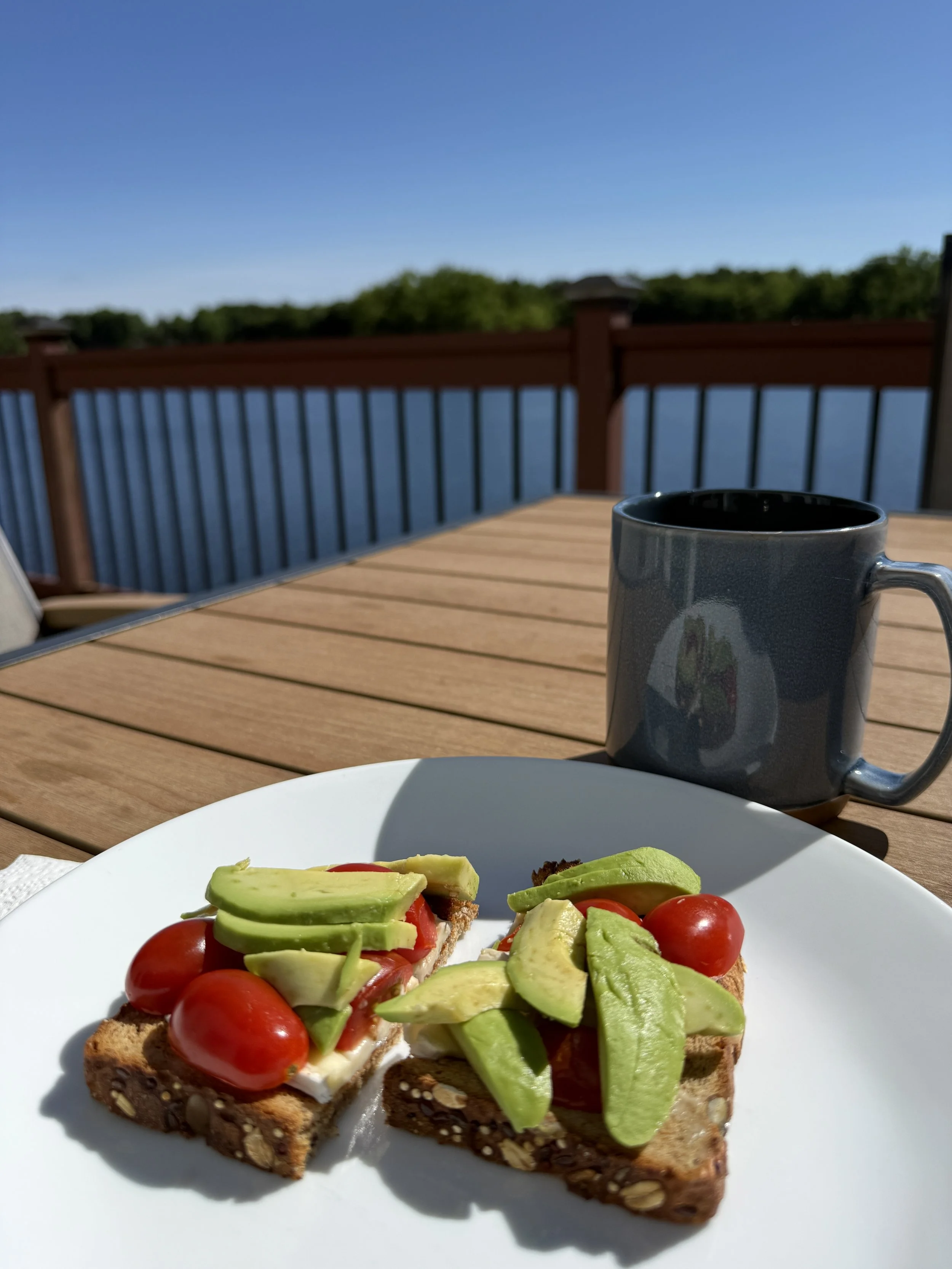
As I sit here to write, my ‘IMAGINE’ mug filled with piping-hot coffee by my side, I’m thinking about the relationship between fresh starts and saying “yes.” I’ve noticed that, especially during this time of year, when I’m reflecting and planning, new opportunities appear. It’s not just their arrival, however. I’m in a more receptive mood, which means I’m more likely to be open and say “yes” to opportunities.

Why is that? Doing something differently or trying something new energizes me. And new changes the mood as one year ends and a new one begins. Possibilities also bring excitement and hope. Doing something different can get me out of a rut, change my perspective, or bring more joy and satisfaction. There are also serendipitous outcomes and benefits that weren’t anticipated.


Three “Yeses” Inspired by the Fresh Start

1. 20 Minutes a Day Challenge

A few of my dear friends invited me to participate in a January movement challenge. The barrier to entry was so low that saying “yes” was easy.

The instructions were simple:

  • Move 20 minutes a day, every day in January.

  • Move in some way. No pressure about the intensity or the type of activity. This could be stretching, yoga, walking, swimming, or any other movement.

  • Text each other daily about what you did or didn’t do. No judgment, only support.

The benefits: The obvious one was that I was more aware of my movement during the day, which felt good. I was less sedentary. Having accountability partners encouraged me to move, even when I didn’t feel like it. The more serendipitous benefit was how much I loved this purposeful, low-pressure daily connection, banter, humor, interaction, and encouragement with my friends.

This ‘yes’ has been such a positive experience that we decided to extend the challenge through mid-February. 


2. 21-Day Tiny Shifts Experience

Dr. Elisha Goldstein, psychologist and author, offered an intriguing program beginning in January. This was another easy “yes.” With a small investment of time and money, he would help us engage in “daily, 3-minute practices to support your nervous system and help you show up differently, one small shift at a time.”

I’m all about small shifts and changes, as it’s integral to my client work. I thought it would be beneficial to try a similar experiment for myself.

During the kickoff meeting, Elisha stressed how this experience wasn’t about “fixing what’s wrong or applying pressure.” It was about:

  • Engaging in “small, repeated moments of regulation.”

  • “Learning to recover faster and more often.”

  • Building resilience.

  • Interrupting stress loops.

  • Experimenting with “nervous system friendly practices.”

  • Understanding that it’s not just about being calm, but about helping you to show up better.

  • Being more grounded and present.

Today’s practice encouraged us to “allow a little more ease,” which is exactly what I’m going to channel today, tomorrow, and going forward. It might even become my 2026 mantra. Thank you, Elisha.

The benefits: I look forward to the daily recorded messages from Elisha, which encourage me to think, relax, and regulate my emotions. The practices are simple and doable. I’m only in the first week, but so far I’ve felt more grounded, taken needed pauses, and feel more present. I’ve been reminded of how powerful the breath is for emotional regulation, and I’ve even integrated it into some of my virtual organizing sessions. I’m also appreciating the community of participants who share their thoughts through a private platform. I enjoy reflecting and learning about what others are experiencing.

“Fresh starts can be invigorating, especially when you embrace new opportunities.”
— Linda Samuels, CPO-CD®, CVOP™

3. Explore Somewhere New – My wonderful husband gifted me a weekend in New York City for my birthday. He planned everything, which was a gift in itself. I always love our time together. I appreciate the simple things we do, like running errands on Saturday morning, kayaking on a lake, walking hand in hand, or sharing meals. Most of our time is spent doing everyday things.

However, for the special weekend, we did things we don’t do every day. It was so much fun. That it happened in January energized the fresh start even more. We visited the Museum of the Dog. Some of my favorite things were playing with the interactive video dog, Molly, and learning about different dog breeds. It made me miss our black lab, Norton. He was an amazing soul.

We also visited the Morgan Library, which I hadn’t been to in years. It has a gorgeous, relatively new wing attached to the historic library. I got emotional when looking at Renoir’s journals and sketches. I had a yearning to draw again like I used to. Who knows? Maybe I will rediscover my art supplies this year.

After visiting two museums, enjoying lots of yummy meals, and an unplanned visit with our kiddos, who were also visiting New York City that weekend, we went on to our next adventure. Across from Grand Central Terminal is the Summit at One Vanderbilt, an immersive art experience with panoramic views of the city. The Summit is located on the 91st-93rd floors of this eco-friendly skyscraper, one of the tallest buildings in Midtown Manhattan, completed in 2021.

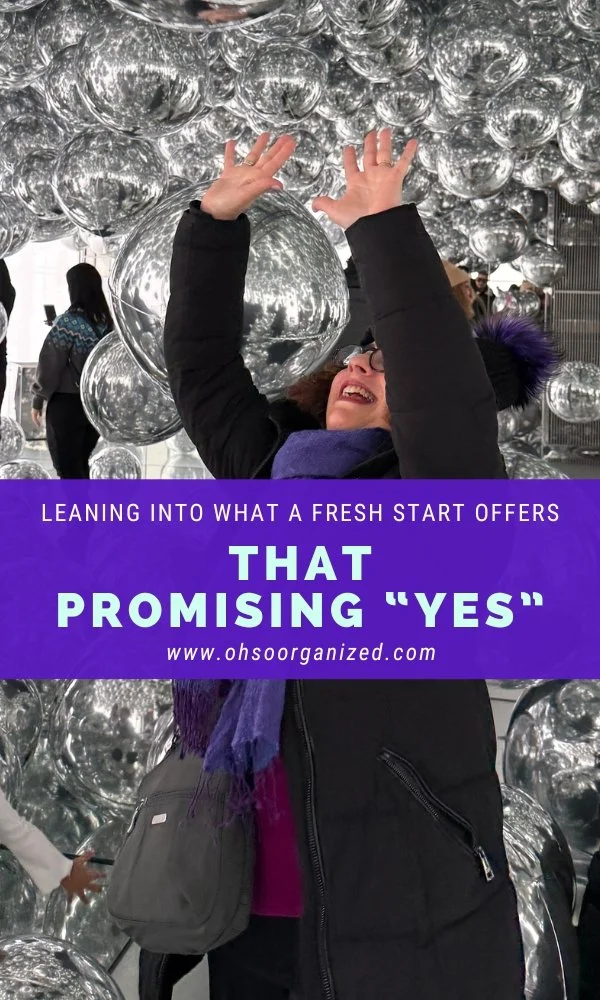
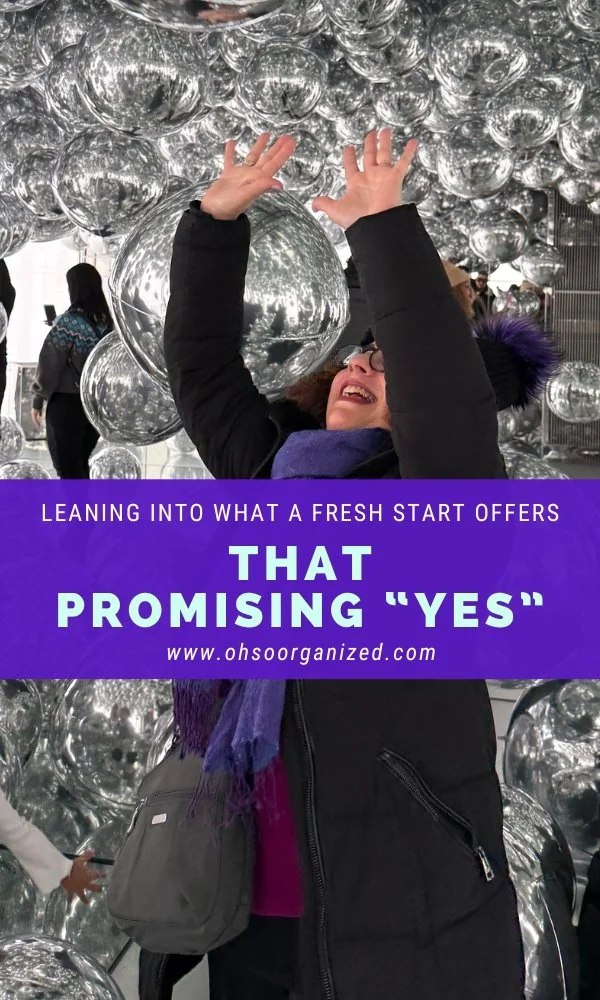
It turned out to be an overcast, cloudy day, so the views weren’t visible. It didn’t matter because there was plenty to explore. Although I would like to go again on a clear day. I loved the Affinity room, where we were surrounded by floating silver balloon-like orbs. It was so much fun catching and throwing them. I felt like a little kid.

My sense of balance and confidence was tested as I walked across mirrored glass floors. You know that wobbly feeling you get when you’re high up? I worked to accept the sensations so I could enjoy the experience.

The benefits: By the end of the weekend, I was vibrating with joy and excitement. Seeing, exploring, and doing new things was uplifting. I wanted to do that more. The weekend helped me celebrate while embracing the newness of a fresh start. The time away also reminded me of things I value: family, connection, art, presence, exploration, learning, curiosity, and experimentation.


What Will Enhance Your Fresh Start?

Fresh starts can be invigorating, especially when you embrace new opportunities. Is there something you said “yes” to this month that you’re glad you did? What have you noticed? Do these ideas resonate with you?

I’d love to hear your thoughts. I invite you to join the conversation.


How Can I Help?

Do you feel overwhelmed, disorganized, or stressed? Would you like to make changes this year? I’m here to help! Virtual organizing is an extraordinary path forward – Local feel with a global reach.

Let’s connect! I’m easy to reach.

Getting organized and making changes are possible, especially with support.