

Posts tagged mind
How to Meet Change with More Compassion and Ease

When you think of compassion and ease, what sensations do you feel in your body? What images come to mind? What stories or messages do your thoughts reveal?

Now, think about change. Are you experiencing sensations, images, and thoughts that feel quite different from those associated with compassion and ease?

No one has the same experience, and yours will likely differ from mine. For me, thoughts of compassion and ease bring calm, care, and gentleness. My breath feels steady and slow. My mind feels clear. I feel more grounded, present, and better able to navigate in the moment.

When I think about change, my initial reaction is to brace. I can feel my shoulders tense, my jaw clench, and a funny sensation in my stomach. Not all change feels that way. Sometimes, positive anticipation and excitement are present. But rarely with change is my first thought or feeling calm or ease-filled.

What becomes possible when you can meet change with compassion and ease?


Meet Change More Gently
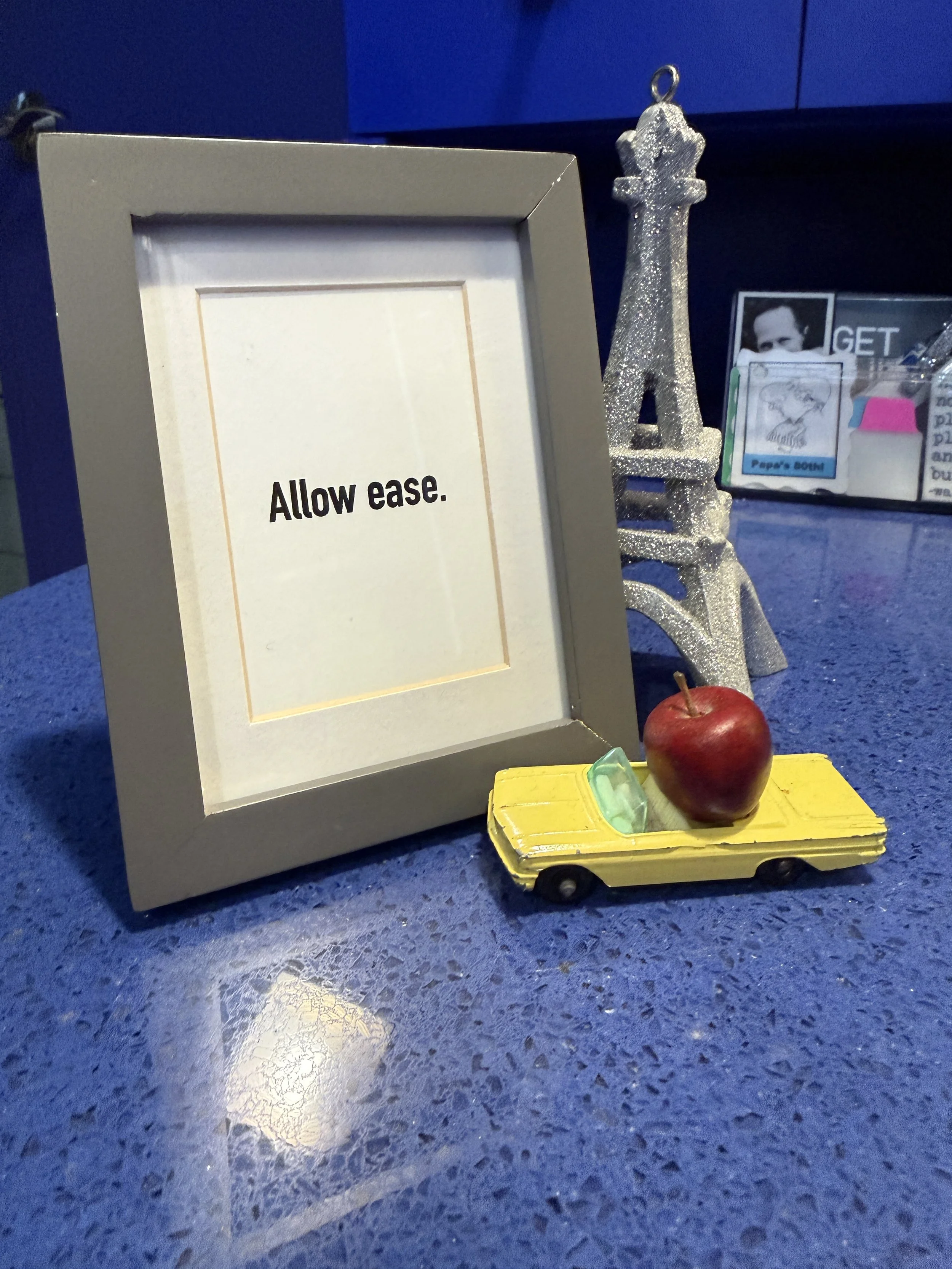
Last week, I wrote about the Tiny Shifts Experience I’ve been participating in, led by Dr. Elisha Goldstein. In one of his prompts, he guided us to “Allow a little more ease” throughout the day.

Before starting the Tiny Shifts program, I had been considering “ease” as my guiding principle, my North Star for 2026. When Elisha encouraged us to “Allow a little more ease,” it confirmed what I was already thinking.

This week, I tweaked the message. My focus for 2026 will be “Allow ease.” I will meet each day, including the challenges, joys, tasks, commitments, and changes I seek, and those thrust upon me, with more compassion and ease.


Engage in Strategies That Encourage Ease

When I notice I’m getting stressed, I will lean on these two strategies.

Strategy 1: Embody Ease with the Breath

This one is so simple. I’ve already used it half a dozen times recently, and it’s incredibly effective. It takes less than a minute.

To Embody Ease:

  • Pause what you’re doing.

  • Gently close your eyes or shift your gaze downwards.

  • Thinking silently, pair these two words while you breathe.

  • Inhale > Allow.

  • Exhale > Ease.

  • Repeat the sequence one or more times until your nervous system calms.

Strategy 2: Ask One Simple Question

You can ask this question on its own, before, or after using the breathing strategy. Listen to what arises and then focus on making a small shift.

Ask this:

Where can I allow more ease right now?

The query will help you identify where your tension or stress lies. How can you change your experience in the moment and lean into more ease? Is there a physical place in your body you can soften? Is there an unhelpful thought loop that needs to be released or noticed? Where is ease possible for you right now?

Where can I allow more ease right now?
— Linda Samuels, CPO-CD®, CVOP™


Can You Shift How You Approach Change?

Change can be exciting or stressful. By integrating strategies that foster compassion and ease, you can move forward with greater grounding and calm. What is your relationship to change? How could creating more ease alter your relationship with change? Which ideas resonate with you?

I’d love to hear your thoughts. I invite you to join the conversation.


How Can I Help?

Do you feel overwhelmed, disorganized, or stressed? Do you want to embrace change this year, yet feel stuck? I’m here to help! Virtual organizing is an extraordinary path forward – Local feel with a global reach.

Let’s connect! I’m easy to reach.

Embracing change and getting organized are possible, especially with support.


12 Favorite Organizing Ideas of the Year That Are Unique and Hopeful

As this year comes to an end, I love reflecting on the past before planning for the future. In this part of my year-end review, I chose my favorite organizing concepts, one from each month of 2025, to share with you.

I hope you discover or rediscover a seed idea that inspires and brings balance to your New Year.

Where do you want more organization and balance? Which people and projects will receive your time, energy, and attention?

If you’re ready for a fresh start, to embrace change, take your next step, let go, declutter, enlist help, and more, this is for you.


12 Favorite Organizing Ideas of 2025

My reset buttons are just little things.
— Glennon Doyle
Encourage change through a lens of positive expectation.
— Linda Samuels, CPO-CD®, CVOP™
…quietly do the next most necessary thing.
— Carl Jung


The ability to simplify means to eliminate the unnecessary so that the necessary may speak.
— Hans Hoffman
Commitment is the powerhouse of the mind decluttering strategy.
— Linda Samuels, CPO-CD®, CVOP™
What will my future-self thank me for doing now?
— Stephanie Sarkis, PhD


The smallest effort can spark the motivation you’ve been missing.
— Linda Samuels, CPO-CD®, CVOP™
It’s a journey to discover what helps you feel, be, and stay organized.
— Linda Samuels, CPO-CD®, CVOP™
Bring curiosity to a dilemma.
— Cameron Gott, PCC


The only limits to the possibilities in your life tomorrow are the ‘buts’ you use today.
— Les Brown
I can transform temporary chaos into an opportunity to reimagine.
— Linda Samuels, CPO-CD®, CVOP™
When the mind is tense, so is the body. When the body is tense, so is the mind.
— Meg Josephson, LCSW


Grateful for You

Thank you for being an essential part of this vibrant community. I am deeply grateful to you. We’ve had an incredible year of conversations and sharing. You bring learning, growth, support, and inspiration to every exchange. Thank you for participating and sharing the best of who you are.

What inspired you this year? Which organizing concept resonates most with you? I’d love to hear your thoughts. I invite you to join the conversation.


How Can I Help?

Do you want help decluttering, organizing, planning, or creating more balance? I’d love to help! Virtual organizing is an extraordinary path forward – Local feel with a global reach.

Let’s connect! I’m easy to reach.

Getting organized, finding balance, and experiencing more calm are possible, especially with support.


5 Simple Practices to Joyfully Reduce Stress and Restore Balance Now

It’s the holiday season. Lights twinkle, gifts get wrapped, and plans are in flux. You’re doing your best to keep up with your daily commitments and the extra effort it takes to navigate this season of celebration, gatherings, and giving. It can be a lot, both wonderful and overwhelming.

On one hand, you have extra time to be with your loved ones and take a break from your normal routines. However, there can also be pressure to say “yes” to all invitations, buy gifts beyond your budget, or overindulge in holiday treats. There are more delicious cookies around than usual. Oh, no!

While the holiday season can be joyful, it can also be stressful, making you feel anxious and out of balance. The good news is that it doesn’t have to be that way.

Recently, I discovered some wonderful grounding practices in “Are You Made at Me? – How to Stop Focusing on What Others Think and Start Living for You” by Meg Josephson, LSCW. These strategies help break the cycle of chronic stress, which negatively affects the mind and body.


Stress: “A Flirty Little Loop”

What is the stress cycle all about? Josephson explains, “The body naturally responds to stress – whether it’s real, remembered, or perceived– with tension, and this response keeps stress and tension going in a flirty little loop.” She describes the four-step cycle:

  • Stressful Happening – This could be internal or external, such as “an anxious thought spiral or someone doing something to make you feel unsafe, whether or not you actually are.”

  • Body Reacts – Your body responds by tensing up.

  • Message Perceived – Tensed muscles send signals to the body indicating that “Something bad is happening! This is stressful.”

  • Cycle Continues – “The tense muscles cue more anxious thoughts, more muscular tension, and more panic.” These reactions perpetuate the stress-and-tension loop.

Josephson says, “When the mind is tense, so is the body. When the body is tense, so is the mind. By first noticing that we’re tensing up, feeling stressed, we can immediately insert a pause into this automatic process and begin to soften our bodies. Being aware of the stress is what allows us to start to break the cycle.”

I will highlight my top five favorite grounding practices from the 14 that Josephson shared. These will help you reduce stress, feel more balanced, present, and calm.

When the mind is tense, so is the body. When the body is tense, so is the mind.
— Meg Josephson, LCSW

5 Simple Grounding Practices to Reduce Stress and Nurture Balance

These techniques can be used at any time during your day when you feel stressed. It all starts with awareness—paying attention to body signals like tense muscles.

1. Increasing Exhale

Elongate your exhale by doing a few cycles where you exhale longer than you inhale. For example, inhale for a count of 4 and exhale for a count of 6. This technique stimulates the vagus nerve, which immediately activates the parasympathetic nervous system, or “rest and digest” mode.


2. Humming

Keep your mouth closed, relax your jaw, and breathe in and out through your nose while making a sound with your vocal cords. The gentle buzzing sound creates vibrations that stimulate your vagus nerve. Singing or chanting can also work because the larynx (the voice box) is connected to the vagus nerve.


3. Sensing with 5, 4, 3, 2, 1

Use your senses to ground yourself by noticing the environment around you right now. Observe what’s nearby, and “Name five things you can see, four things you can feel, three things you can hear, two things you can smell, and one thing you can taste.”


4. Using Your Hands

Research shows that “effective touch” is a stress reliever. This can include self-touch. Notice where you feel tension. Place your hand or palm on that area and breathe deeply. For example, if you’re feeling tension in your chest, put your hand there and breathe several times. This practice is calming and reduces stress.


5. Dancing

This practice feels especially fun during the holiday season. Of course, you can do it anytime. Dancing helps integrate movement and breath. It connects you to your body and takes you out of your head. Play your favorite tune and dance away.


How Do You Manage Stress and Invite More Balance?

It’s the season for joy and delight. But when you’re feeling stressed and off balance, accessing that joy can be difficult. Which of these five grounding practices resonates most with you? What else helps you feel grounded, calm, and balanced?

I’d love to hear your thoughts. I invite you to join the conversation.


How Can I Help?

Do you feel overwhelmed, disorganized, stressed, or out of balance? Would you like to make progress? I’m here to help! Virtual organizing is an extraordinary path forward – Local feel with a global reach.

Let’s connect! I’m easy to reach.

Getting organized is possible, especially with support.
 
 
3 Simple Ways to Improve Your Motivation and Get Unstuck

Motivation isn’t always there before you start what you want to do. It might be, but more often it shows up after you begin taking action. The mind can play tricks on itself and psych you out. It dwells on reasons why you can’t start or reach your goal

When that happens, motivation disappears, progress is elusive, and you feel stuck. You’re at an impasse. You can remain in this limbo, negative state, or you can turn things around.

If you’re ready to change the dynamics, I have some ideas to help. There are many ways to get unstuck, boost your motivation, and act on what matters most. I compiled three approaches related to focus, fear, and perspective.


3 Simple Ways to Improve Your Motivation and Get Unstuck

1. Motivation and Focus

Focus on the seeds, not the trees. What seeds are you planting today?
— James Clear

A common reason for a lack of motivation is feeling overwhelmed. It’s important to understand your overall goal or objective. However, focusing too far in the future on what it will take to reach that goal can be demotivating.

Instead, narrow your focus and stay present. This will help boost motivation. Invest in small actions that support your larger goal. Keep your attention on the now and your next step, while remembering your ‘why’.

Eventually, the seeds you plant will grow into the trees you desire.

REMEMBER: “Focus on the seeds, not the trees. What seeds are you planting today?”James Clear


2. Motivation and Fear

Any next action.
— Linda Samuels, CPO-CD®, CVOP™

A few months ago, Kara Cutruzzula, a writer, playwright, lyricist, and friend, wrote a piece on Substack called “Hop to the other side of fear.” She shared how being unprepared and scared can get in the way of progress, yet these are fixable challenges.

In response, I commented that fear, indecision, and uncertainty can be paralyzing and demotivating. However, taking any next action can help break that cycle.

  • What fears are holding you back?

  • What decision are you struggling to make?

  • How can you get ready to take the next small step?

  • How is uncertainty preventing you from moving ahead?

Taking action holds undeniable power. It encourages further progress, boosts motivation, quiets fears, and helps you move forward.

REMEMBER: “Any next action.” Linda Samuels, CPO-CD®, CVOP™


3. Motivation and Perspective

Make your what-if questions positive, not negative.
— Todd Henry

Someone once suggested to me that it’s unhelpful to ask ‘what-if’ questions. Honestly, that has never prevented me from pondering them. How you phrase the ‘what-ifs’ is essential.

Especially when you’re feeling stuck and lacking motivation, it’s more helpful to reframe your ‘what if’ questions from an optimistic perspective.

Instead of dwelling on:

  • What if I never get my home organized?

  • What if I don’t complete this decluttering project?

  • What if I can’t change my unhelpful habits?

Instead try:

  • What if I make my home organized enough so that our family feels calmer and less stressed?

  • What if I finish this decluttering project so I can downsize to my new home?

  • What if I change my bad habits to feel healthier and more energetic?

‘What if’ questions can motivate and encourage action when they are framed to highlight positive outcomes.

REMEMBER: “Make your what-if questions positive, not negative.”Todd Henry


What Motivation Strategies Are Most Effective?

If “action precedes motivation,” as Julie Bestry, my friend and colleague, says, what helps you take that next step? Do you have motivational challenges? Which of these strategies resonates most with you?

I’d love to hear your thoughts. I invite you to join the conversation.


How Can I Help?

Do you need support with motivation, activation, or organization? I’d love to help! Virtual organizing is an extraordinary path forward – Local feel with a global reach.

Let’s talk. You can:

Organizing and sustaining motivation is possible, especially with support.